What Gongfu Cha means
Gongfu tea — known in Chinese as Gongfu Cha (工夫茶) and often called "the Chinese tea ceremony" — is not a performance. It is a method: making tea with skill. Gongfu (工夫) here means time, care, and practiced effort — the same word used for craftsmanship. Cha is simply tea.
If you are asking "what is gongfu tea?" in practical terms, it is small-vessel brewing with more leaf, less water, and many short infusions.
The method has three working principles:
- More leaves. A small vessel is filled a third or more with leaf — far more than Western mug brewing.
- Less water. A gaiwan or small pot of 100–150 ml, not a large teapot.
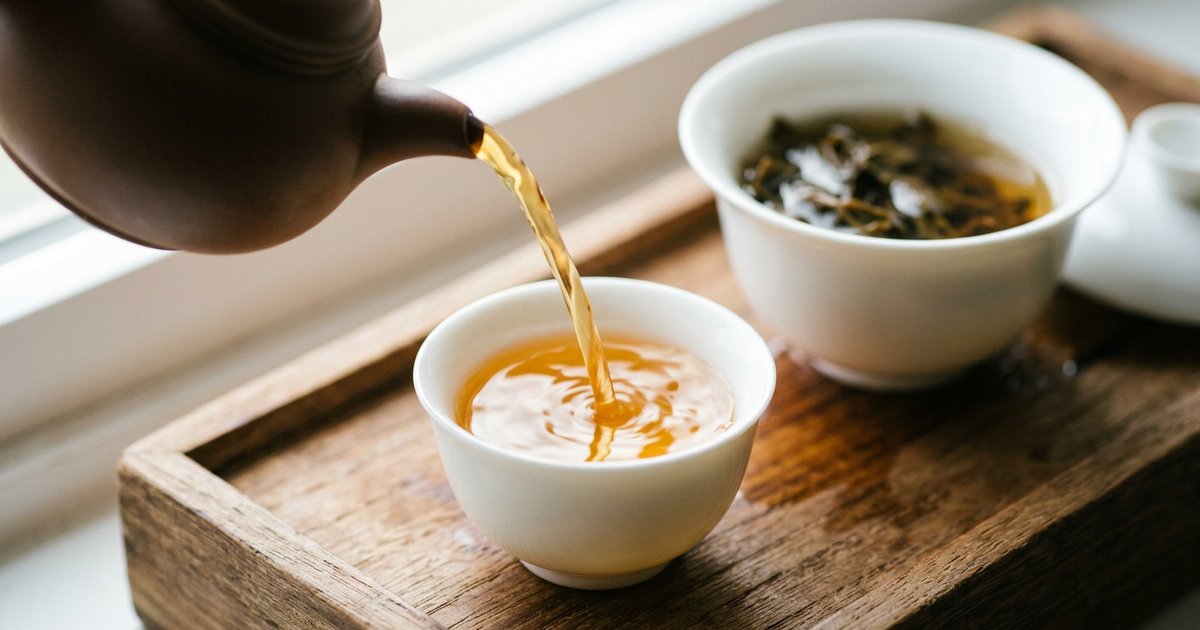
- Many short infusions. The same leaves are steeped again and again — five, ten, sometimes fifteen times — with each infusion lasting seconds, not minutes.
The result is a series of small, intense cups, each one slightly different from the last. Instead of one flat extraction, you taste the tea unfold: aroma first, then sweetness, then texture, then the long mineral finish the Chinese call huigan (回甘, "returning sweetness").
Tea is drunk to forget the noise of the world. One small cup at a time, the session slows you down to the speed of the leaf.
Where it comes from
Tea drinking in China is ancient — Lu Yu's Classic of Tea (《茶经》) was written around 760 AD — but Gongfu Cha as we know it today took shape much later, in the Chaozhou (潮州) region of Guangdong, in the eighteenth and nineteenth centuries. Chaozhou sits at the southern end of the Wuyi-to-Canton tea routes, and its people brewed the local Phoenix Dancong oolongs in tiny pots with tiny cups, because that is what showed those famously aromatic teas at their best.
The practice was so characteristic of the region that "Chaozhou Gongfu Cha" became a set phrase. In 2008, the tea art of Chaozhou (潮州工夫茶艺) was inscribed on China's national list of intangible cultural heritage, and in 2022 the traditional tea processing techniques of China — including the customs around them — were added to UNESCO's Representative List of the Intangible Cultural Heritage of Humanity.
Today Gongfu Cha is brewed everywhere in China and increasingly abroad, but the Chaozhou style remains the reference: three small cups on a tray, water at a rolling boil, and a host who brews for you, round after round.
Not the Japanese tea ceremony
Western readers sometimes meet Gongfu Cha through its more famous cousin, the Japanese tea ceremony, sadō (茶道). The two share ancestors but diverged centuries ago, and the difference is worth knowing:
| Gongfu Cha (工夫茶) | Japanese sadō (茶道) | |
|---|---|---|
| Tea | Loose-leaf, usually oolong, pu-erh, red | Powdered matcha |
| Vessel | gaiwan or small clay pot | Whisked in a single bowl |
| Form | Flexible, conversational | Highly choreographed |
| Focus | The taste of the leaf, infusion by infusion | The totality of the gathering — ichigo ichie |
| Infusions | Many short steeps | One bowl per guest |
Where sadō formalizes a single perfect meeting, Gongfu Cha stays practical and social: friends around a tray, conversation flowing, the host adjusting each infusion to the leaves' mood. The ritual serves the tea — never the other way around.
The basic tools
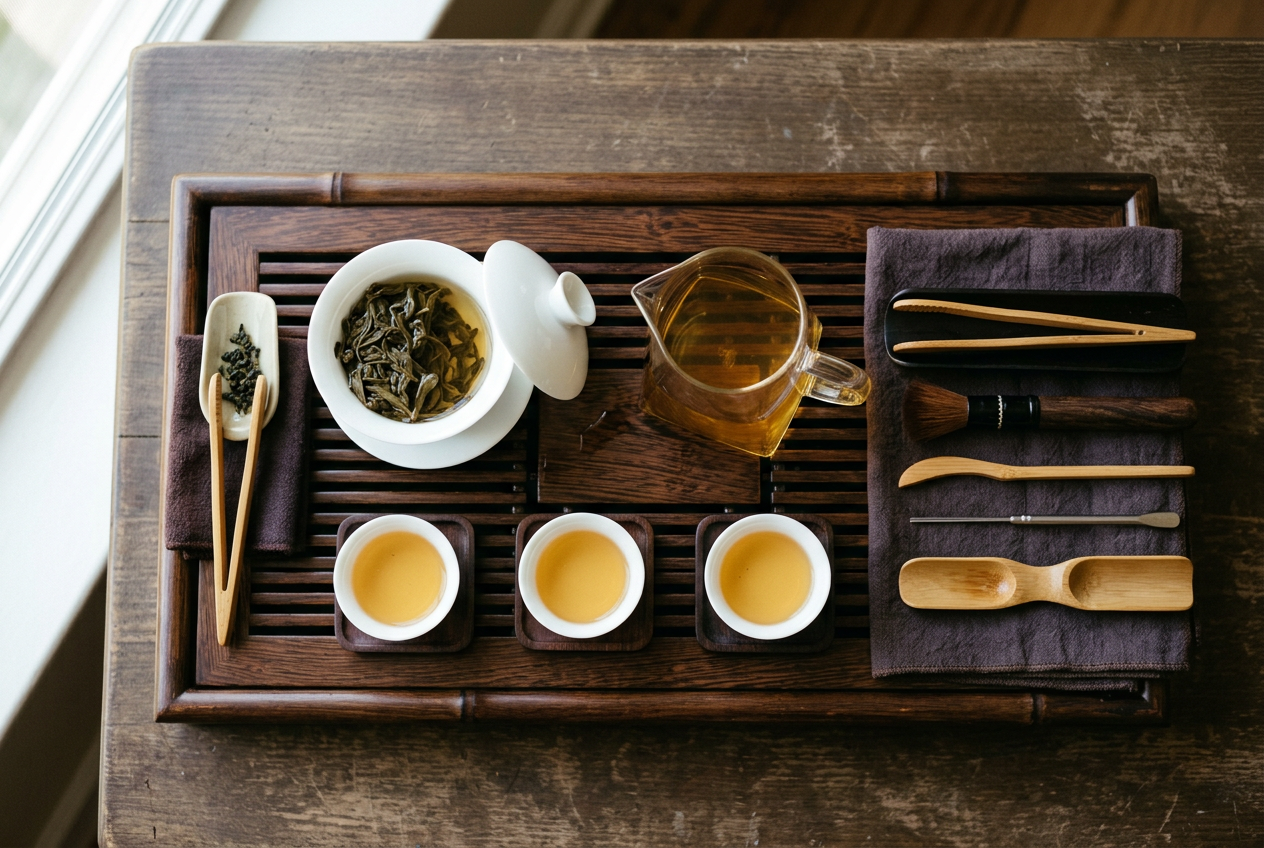
You can begin with very little. The essential set has four pieces:
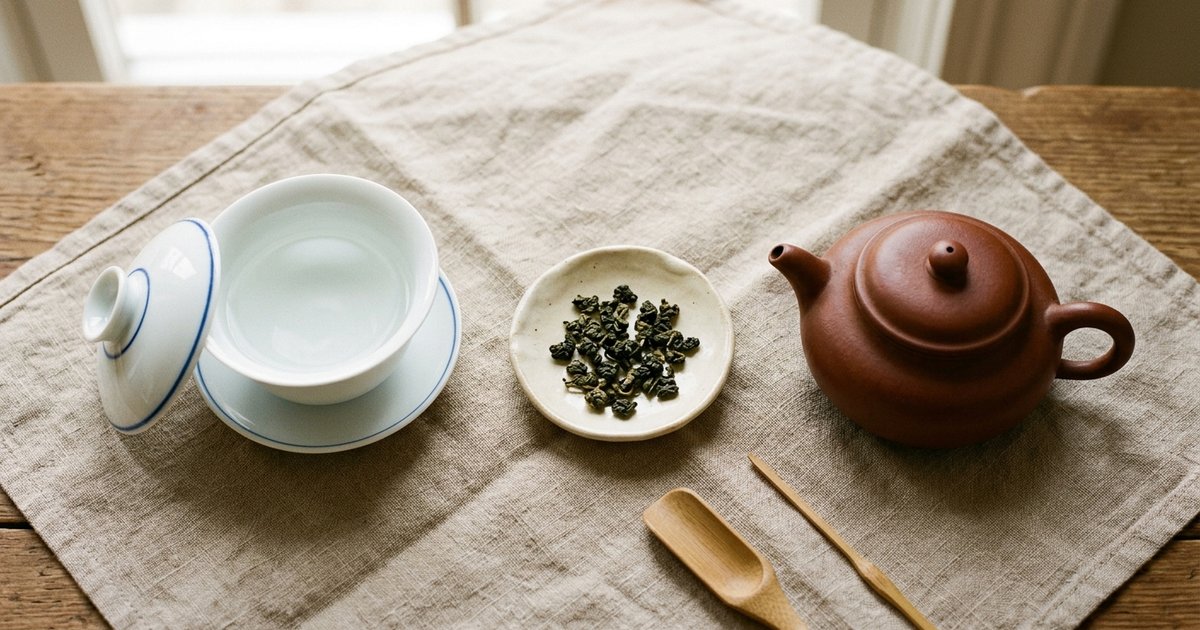
- Gaiwan (盖碗) — a lidded porcelain bowl, the most versatile brewing vessel. It shows the leaves, pours fast, and works for every tea family.
- Fairness pitcher (公道杯, gongdao bei) — a small pitcher the liquor is poured into first, so every guest gets tea of the same strength.
- Tasting cups (品茗杯) — small cups, often porcelain, emptied in two or three sips.
- Tea tray (茶盘) — a slatted or drained tray that catches rinse water and overflow, keeping the table calm and dry.
Later you may add a clay pot from Yixing, a tea pet, aroma cups, and tools for breaking pu-erh cakes — but none of them are required. A gaiwan, a pitcher, two cups, and good leaves are a complete ceremony.
Your first session
Choose a forgiving tea — a roasted oolong or a ripe pu-erh is kinder to beginners than a delicate green. Then:
- Warm everything. Rinse the gaiwan, pitcher, and cups with boiling water. Warm vessels keep the infusion hot and awake the leaves.
- Measure the leaf. Fill the gaiwan roughly one-third full — about 5 grams for 100 ml.
- Rinse the leaves. A quick five-second steep, poured off. This washes the leaf and opens it up.
- Brew short. First true infusion: ten to fifteen seconds, water just off the boil for oolong and dark teas. Pour everything into the fairness pitcher, then into the cups.
- Repeat and extend. Add a few seconds to each round. Watch how the aroma moves from the lid to the liquor to the empty cup.
That is the whole ceremony. For a fuller walkthrough of hosting guests, see our step-by-step guide to hosting a Gongfu tea ceremony. To choose your next tea, start with our guide to the six families of Chinese tea and then use our brewing temperature guide to dial in the water. Everything else — the water, the season, the company — you learn by pouring. Brew the same tea ten sessions in a row and by the eleventh you will know more about it than any article can tell you, including this one.